


Article
Interview: Gemini VIII Recovery Pilot
By: Logan Rex | March 16, 2026 (6 minute read)
Wapakoneta, OH — For the sixtieth anniversary of the Gemini VIII mission, the Armstrong Air & Space Museum sat down with Gemini VIII recovery pilot Les Schneider to get his perspective on that eventful day in the Pacific Ocean and to learn more about the mission after splashdown.
Q: When joining the US Air Force, did you ever imagine that your path would intersect with a NASA space mission recovery?
Schneider: "No. That was probably the farthest thing from my mind. I was a 17-year-old entering the Air Force Academy and it was actually only going to the Air Force Academy that I ended up flying. So, it took awhile to make up my mind exactly where I was going once I graduated from the academy, but flying was a logical choice. Sounded pretty exciting. But, no, I never actually considered anything relative to the space program, no."
Q: What were your initial thoughts and reactions to learning about the emergency splashdown for Gemini VIII?
Schneider: "Well that's an interesting question because I was sitting in an alert shack on Okinawa, Naha Air Base, standing by in case of an emergency and we had no information at all that the emergency was ongoing. It was a shock when we got launched because nothing had happened in the space program up to this point and we didn't expect anything. So I wasn't aware of what was going on, we were preparing our aircraft, getting ready to standby, which we did at 7 o'clock in the morning that day. But, the emergency was actually ongoing while we were getting ready to standby. So, we didn't really know anything about the emergency... and then we got launched."
Q: Base on your previous training for an emergency scenario, do you think your recovery of the crew and craft went as planned? Did anything unexpected occur?
Schneider:
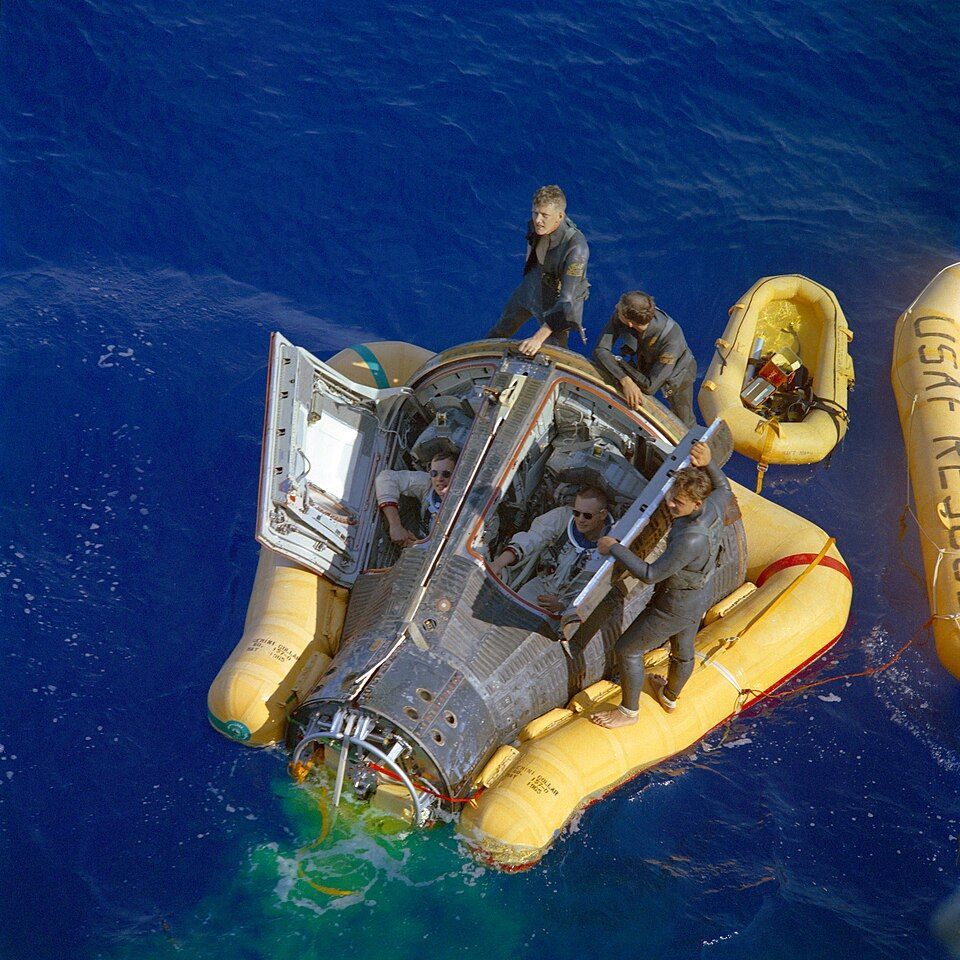
"Well let's start with the recovery wasn't planned, nobody expected this to happen. In all honesty, I was a bit of a neophyte in the rescue business. I had only been in rescue for five months when this happened. I'd had only the basic training in this type of recovery. So, a lot of the recovery was basically seat of the pants. It certainly went well, but, it... it had to be seat of the pants at the time because nothing like this had ever happened before; no rescue or recovery like this had ever been done before. So, even though I was prepared as far as the basics of dropping the Pararescuemen for example, the recovery itself was moment by moment, I had to improvise a lot of what I did. Fortunately, for everyone concerned, it worked out well."
Q: Did you fully understand the extent of the emergency in space when recovering the astronauts? If not, when did you learn about the full story of the emergency?
Schneider: "Well the first part of the question, no I didn't understand the nature of the emergency when we got launched. In fact, none of us on my crew really thought it was a legitimate launch, we thought it was just a practice. But, all of a sudden, we're en route to a splashdown point and we're getting all the information about splashdown times and location. Well, it finally sunk in that this was for real. So, no we didn't understand what had happened, we didn't understand the extent of it, but we realized all of a sudden, that this was the real deal. And we were going to try to locate and recover Gemini VIII.
It was days after, it was after we had returned, the mission was complete, we were back at Naha Air Base. We were in our quarters and eventually reporters came to interview us as a crew. It was during this whole process that we were exposed to the details of the emergency. So it was days after the fact that we actually learned about it."
Q: What are some misconceptions about the mission or your recovery that you have heard and would like to set straight?
Schneider: "Well, yes. Over the years, the biggest misconception is that I was flying a helicopter. I was flying a four engine, old WWII, fixed-wing airplane. And I know a lot of people have a hard time understanding how you can recover a capsule floating in the ocean with a fixed-wing airplane, you know. So, the biggest misconception was that we were a helicopter. That's persisted over the years, I've even seen in recent months and weeks references to a helicopter recovery. There were no helicopters there; there were none available. We were, the landing place, the contingency landing, was too far out at sea for a helicopter at that particular time.
The other misconceptions were, that there were Navy frogmen that jumped to it. Well, they were Air Force Pararescuemen. Right, not Navy frogmen, however, much respect I have for those guys. But, that's another thing, the news media, in their attempt to cover all this, made a lot of mistakes along the way. Just honest mistakes. They even got my name wrong a lot of times. It was sort of amusing to read some of the accounts of this. But, that's one of the reasons I speak frequently about Gemini VIII, try to set the story straight."
Q: Neil invited you to the Apollo 11 launch. When watching, did you have any worries about the mission and did you think they would be successful?
Schneider: "No. That never even occurred to me. Gemini VIII was one unique emergency. After that, the program continued unabated with no additional [inflight] emergencies. It was very smooth from there on. I had full confidence, of course, in Neil, as a pilot and as an astronaut. I was confident that they were ready."
Q: Looking back now, how important do you think Gemini VIII was for paving the way to landing on the Moon three years later?
Schneider: "Crucial, in a lot of different ways. Number one, the docking maneuver that they accomplished successfully, before the emergency in space, was essential to getting us to the Moon. There were many docking maneuvers that had to occur, going and coming back from the Moon. So, the docking maneuver was critical. So they showed that that could be done and it was done well.
The fact that Neil was able to get that spacecraft under control under those dire circumstances was amazing. If Gemini VIII hadn't been successful, either the recovery in space or the recovery at sea, either one of those could have stopped the whole progress of the space program. And, I seriously doubt that it would have progressed fast enough after that. It would have stalled out, and we would not have made Kennedy's hope, plan, and desire that we would have made it to the Moon in that decade. I don't think it would have happened."
Q: Based on what you've seen and your correspondence with Armstrong, what do you think about Neil's overall character as a person and astronaut?
Schneider: "Oh my. There was no better man and no better pilot than Neil Armstrong. He was humble, incredibly capable, simple in his way. He was dedicated, professional, and I got to admit, he wasn't the friendliest person. Our relationship was, you know, a professional occurrence, an event that sort of tied us together. I would have never called us friends. But he was always so cordial, pleasant, whenever I spoke to him, when I met him.
He was a unique pilot, if you go back through all his history, the things he did. The emergencies, even when he was practicing the LM, and the LM went out of control and he managed to get out of that LM before disaster happened and it crashed. The thing like this is his speed of reaction, he was just such a talented individual. And so like I said earlier, very humble. Didn't want publicity. Didn't want anything for himself, really. He was dedicated to doing what was needed of him, what he was called upon to do. Very, terribly unique and I think probably the best choice for that first man on the Moon."
Q: What do you want people to take away from the lessons learned on Gemini VIII, especially in regard to our planned return to the Moon for the Artemis program?
Schneider: "That's a rather large question. Preparedness for any eventuality. Our technology today is so far beyond what it was with Gemini, it's even amazing to think of where the technology was when they managed to do the Gemini VIII program and up leading to the Moon. Our technology is incredible today. Nevertheless, you can never assume. Never assume it's all going to go right, that everything is going to work right. You're going to have backup plans, you're going to have to have... the awareness that not everything is going to go right. At all. And there could be some significant problems down the road. Hopefully, we'll overcome anything that comes along. We certainly got the dedication and the motivation to reach that goal. I think we will."
Q: What has been your favorite aircraft to fly?
Schneider: "Just like the Gemini VIII recovery was a unique moment in my life. Flying that old World War II type DC-4 has a special place in my heart. I had never flown anything reciprocating before they put me in this on Guam those five months before Gemini VIII. I had never flown a reciprocating airplane, ever. I had always flown jets and prop jets, so it was unique. You know you think in the history of aviation, going back to the early days, the pilots, the type of airplane they had to fly, I sort of made a connection with that era, flying that DC-4. I only flew it for eight months actually, total. That connected me with the earlier history of aviation. So for that reason, it's always going to be the number one place in my heart as far as aviation is concerned."
Q: Is there anything else you'd like to add to the interview?
Schneider: "Only one thing. For whatever reason, because the type of man [Neil] was, because of our unique rendezvous. Matter of fact, in one letter he sent me, he called the Gemini VIII recovery the most unique rendezvous in history of aviation. Between a Gemini VIII capsule and an old relic of an old World War II airplane, you know. I kept in touch with him, over many years. When he passed away... I felt it deeply. He was a unique man, he was an incredible pilot, astronaut, a human being. It was a great loss; he was gone too early. I will always feel that deep connection with him, with the space program in general, and I am happy to have been involved in it."
[Interview was conducted March 16, 2026 at the Armstrong Air & Space Museum in Wapakoneta, Ohio, by Logan Rex]
share this
Related Articles
Related Articles