




OUR HISTORY
History of Ohio's
MOON BASE
The Armstrong Air & Space Museum in Wapakoneta, Ohio, was created to honor the life and achievements of Neil Armstrong, the first person to walk on the Moon, and to preserve the story of Ohio's contributions to space. Since opening over fifty years ago, the museum has become one of the nation's leading destinations for space history, STEM education, and the legacy of Apollo 11.
When Neil Armstrong stepped onto the lunar surface during the Apollo 11 mission on July 20, 1969, he forever changed humanity. As the world watched, Wapakoneta, Armstrong's hometown, found itself at the center of international attention. Reporters from around the globe traveled to the community to learn more about the humble Ohio aviator who had become the first human to walk on another world.
Following the successful Moon landing, thousands of people gathered in Wapakoneta to celebrate Armstrong's return. Among those attending was Ohio Governor James A. Rhodes, who believed Armstrong's achievement and America's space exploration accomplishments deserved a permanent home in Ohio. On July 21, 1969, while Armstrong was still on the lunar surface, plans were announced for a museum dedicated to the Apollo 11 commander and the history of aviation and spaceflight.
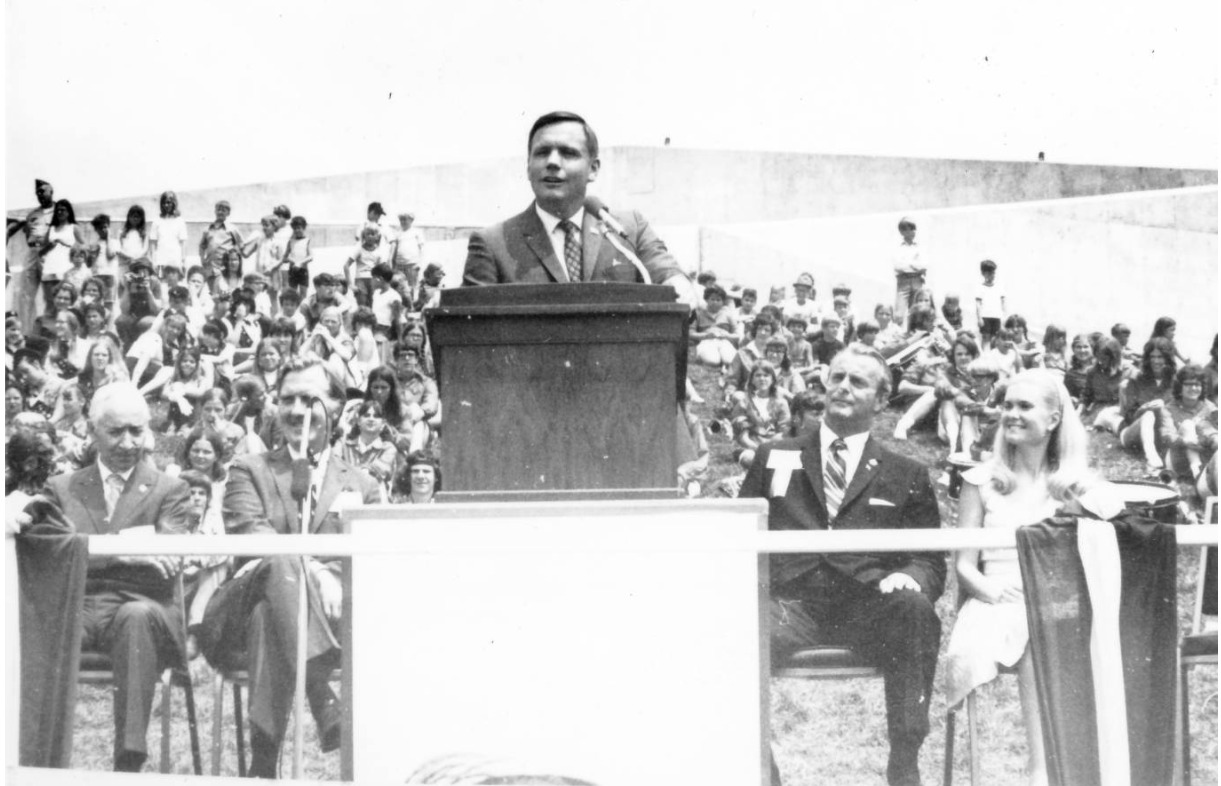
Rhodes pledged $500,000 in state money towards the $1 million dollar project, challenging the local community to match the other half. The community rapidly responded, exceeding the amount and contributed $528,313.55. The Armstrong Air & Space Museum was formally dedicated on July 20, 1972, exactly three years after the Apollo 11 Moon landing. Special guests included Armstrong and his family, state and federal legislators, and Tricia Nixon, the daughter of then-president Richard Nixon.
The museum itself was groundbreaking. Designed to resemble a futuristic lunar outpost, it is widely recognized as the world's first public building based on lunar base architecture concepts developed during the Apollo era. Its distinctive design reflects the optimism and vision of the Space Age, when scientists and engineers were actively planning humanity's future on the Moon. More than fifty years later, the museum remains one of Ohio's most recognizable architectural landmarks.
The Armstrong Air & Space Museum also holds several unique distinctions. It was the first museum in the world named after an astronaut and remains one of the few museums dedicated to a single astronaut's life and career. Today, the museum is home to one of the world's largest collection of artifacts associated with Neil Armstrong, including aircraft, spacecraft, personal memorabilia, awards, and historical items that document his remarkable journey from small-town Ohio to the surface of the Moon.
During its early years, the museum welcomed more than 100,000 visitors annually as people from across the United States and around the world traveled to learn about Apollo 11, the Space Race, and Neil Armstrong's historic achievements. As interest in space exploration evolved, so did the museum. In 1999, a major expansion added the Modern Space Gallery, creating new exhibit space dedicated to the Space Shuttle Program, contemporary space exploration, and the future of human spaceflight. The expansion allowed the museum to tell a broader story of space exploration beyond the Apollo era and showcase emerging technologies and missions.
In 2009, state budget reductions threatened the future of the museum. Rather than allowing this important landmark to close, local leaders, supporters, and volunteers formed the Armstrong Air & Space Museum Association, a nonprofit organization dedicated to preserving and operating the museum. Through a partnership with the Ohio History Connection, the museum remained open and continued serving visitors from around the world.

The museum entered a new era of growth in 2019 with the opening of the Neil A. Armstrong STEM Inspiration Center. This state-of-the-art educational facility expanded the museum's mission beyond preservation and interpretation by creating hands-on learning opportunities focused on science, technology, engineering, and mathematics. The STEM Inspiration Center provides innovative programming, interactive experiences, and educational opportunities designed to inspire the next generation of explorers, engineers, scientists, and innovators.
Today, the Armstrong Air & Space Museum welcomes approximately 40,000 visitors each year and serves as a center for education, inspiration, and discovery. Visitors can experience nationally significant artifacts, explore the history of aviation and spaceflight, learn about the Apollo program and modern space exploration, and discover how ordinary people can achieve extraordinary things.
More than half a century after humanity's first steps on the Moon, the Armstrong Air & Space Museum continues to preserve the legacy of Neil Armstrong, celebrate the achievements of the United States space program, and inspire future generations to reach for the stars.